Connect Therapy and the Thoracic Ring Approach
Understand What’s Actually Driving Your Pain
If your pain keeps coming back, or you’ve seen multiple practitioners without lasting improvement, it is worth asking whether the source of the problem has actually been identified.
Many people have tried treating the painful area directly, stretching, and strengthening, without finding a lasting solution. Often, this is because the area that hurts is not the area that is driving the symptoms.
At Cadence Physiotherapy & Rehab in Vancouver (near Cambie & Broadway), we use ConnectTherapy™ and the Thoracic Ring Approach to assess how your body is working as a whole and identify what is actually causing your pain.
Why Pain Doesn’t Always Come From Where You Feel It
The body is highly interconnected. Some regions influence others in ways that are not always obvious, and treating only the painful area often produces temporary relief rather than lasting change.
For example, one person’s knee pain may be driven by how their foot is loading. Another person’s knee pain may be influenced by how their rib cage or pelvis is moving. The location of the pain tells us where the problem is being felt, not necessarily where it is coming from.
This is the central idea behind treating the body as a whole through ConnectTherapy™.
What Is ConnectTherapy™?
ConnectTherapy™ is a structured approach to understanding how different parts of your body are connected and how they influence each other.
Instead of focusing only on where it hurts, we:
- Assess the painful area
- Look at how your whole body is moving
- Identify other regions that may be contributing
For example:
- One person’s knee pain may be driven by their foot
- Another person’s knee pain may be influenced by their rib cage or pelvis
This approach helps remove guesswork and creates a clear path forward.
The Role of the Rib Cage (Thorax)
The rib cage is one of the most important—but often overlooked—areas in the body.
It:
- Plays a major role in spinal movement, especially rotation
- Connects to the neck, shoulders, and pelvis through multiple muscle systems
- Influences breathing, posture, and overall movement patterns
Because of these connections, changes in how your rib cage moves can affect joints from head to toe.
What Is the Thoracic Ring Approach?
The Thoracic Ring Approach is a specific way of assessing and treating the rib cage.
Your rib cage is made up of thoracic rings — each including:
- The ribs
- The spine
- The sternum
When these rings are not aligned or moving well, your body often compensates by:
- Increasing muscle tension
- Limiting movement
- Changing how other areas function
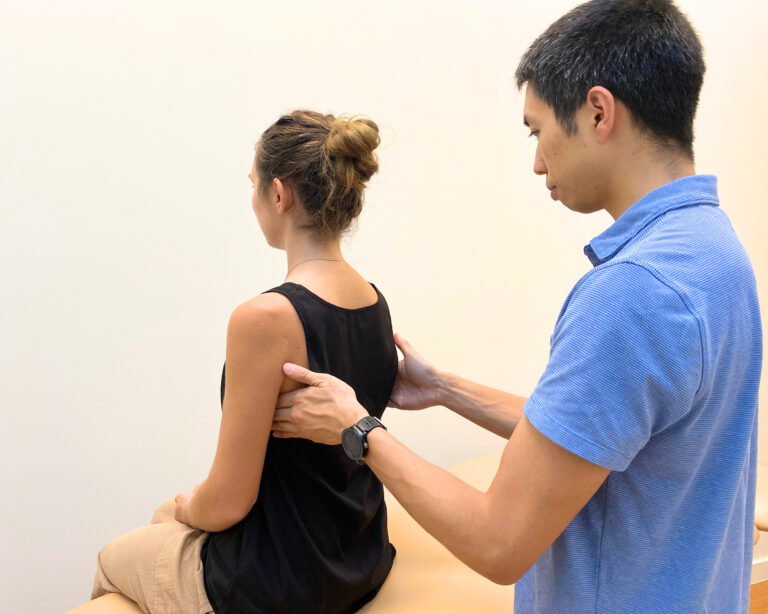
We use precise, hands-on techniques—often applying pressure to the side of the ribs—to improve how these rings move and interact.
This allows us to create meaningful changes in the thorax and spine in a way that is often more effective than treating from the back alone.
What to Expect
- Full-Body Assessment & Identify the Key Driver(s)
Your physiotherapist will complete a detailed assessment of how your whole body moves to identify the key areas contributing to your symptoms. We determine which areas are most influencing your pain—not just where it hurts, but what’s actually driving it. - Targeted Treatment
Treatment is focused on the areas that will make the biggest difference. This may include thoracic ring techniques and other hands-on approaches. - Integration Through Movement
You’ll be guided through specific exercises to support the changes and improve how your body moves day-to-day. - Clear Plan Forward
You’ll leave with a clear understanding of what’s contributing to your symptoms and what to focus on moving forward.
Who This Is For
This approach is particularly helpful if you:
- Have pain that keeps coming back despite treatment
- Have discomfort in multiple areas
- Have not found lasting results with previous physiotherapy or other practitioners
- Feel that the underlying cause of your symptoms has not yet been identified
Why Choose Cadence Physiotherapy & Rehab
- One-on-one, 60-minute assessments
- Structured, whole-body approach
- Focus on understanding—not guessing
- Clear plan based on your specific presentation
Find Out What’s Actually Driving Your Pain
If your symptoms have not fully resolved, it may be worth looking beyond just the painful area.
Book an assessment and take a more targeted approach to understanding your body.
Frequently Ask Question
Commonly Asked Questions & Answers
Have questions about our approach, treatments, or what to expect during your visit? We’ve gathered answers to the most common questions to help you feel informed, comfortable, and confident before booking your appointment.